“April is the cruelest month, breeding lilacs out of the dead land, mixing memory and desire, stirring dull roots with spring rain.” T.S. Eliot
Casey Gilfillan
I went for a walk this morning around seven o’clock, long before the midday sun sets in and brings with it an intolerable heat and glaring spotlight. I enjoy the feeling that I am experiencing the day before it is ready for me; the sky a soft grayish-blue, the air still crisp from the evening before.
Misty rain trickled down and I was enveloped by a wave of fog as I walked from my apartment towards the wealthier side of town. The transition from the bundled shops and skinny, brick duplexes to luxurious homes with exuberantly green and ornately groomed front laws was drastic. The residential roads on the northern side of town have nearly impermeable overhead coverage, as they are heavily populated by trees that mimic skyscrapers in height and soften the sun’s harmful intensity. I saw some scattered bits of Easter decor – a wooden rabbit cutout, cardboard renditions of dyed eggs, and a sign that read “silly rabbit, Easter is for Jesus” – staked into various lawns.
In April more than any other month, I need to be distracted from the frothy seasonal garbage, peddling oppressive familial and religious values through the commercial dominion of Easter. Popular fashion strays from the hushed hues of winter and embraces indulgent smears of pastel, dimensionless renditions of color complemented by white accents. Windows and storefronts are engrossed by Easter eggs, crosses, and fuzzy yellow ducklings. Families flock to the local parks, ambitiously geared to navigate public walkways. They tug the walking children along by hand while wheeling around the smaller ones, and I confine myself to the most borderline edge of the pathway to avoid a collision. I look as the children try to pull away from and run ahead of their parents to the ducklings pooled around the water’s edge; I cannot help but think the parents must be exhausted. I think about walking around the trail as I am, except with a child in tow who is possessed by belligerent curiosity. I cannot help but wonder about an appeal that is so foreign to me.
I am not enticed by lofty proclamations of rebirth and renewal, marked by the arrival of the spring season. The air is sticky and dense, dampened by rainfall and baked by the warming Earth. It is humid outside and I am condemned by desperation to compounded suffering in my need for a jacket to guard from the rain. It is in this moist cesspool of newly-surfaced insect life that people try to manifest rejuvenation through seasonal deep-cleaning. How authentic can personal renewal be if it is marked by collective trend or social calendar? I am not taken by these cleansing fads, and rather am tempted to reject them outright by amplifying the most self-destructive parts of myself. Why it is the case that I cannot comply with the compulsive social mannerisms of those around me and so often find myself in a self-sabotaging antithesis, I am not sure.
As the Easter season looms ominously over the month, it overcasts any nature-inspired joy with burdensome religious obligation. Forgiveness, repenting, humble submission to sinful nature, and performative restriction are the encouraged themes. The same park-roaming toddlers are groomed and wrapped up with frills, lace, and buttons to attend dinner in the middle of the afternoon with cousins they likely won’t see again until Christmas. Plastic eggs with coins and chocolate are employed as a means of motivating the children to care about the holiday, scattered lazily throughout the backyard by adults who give credit to a mythical rabbit.
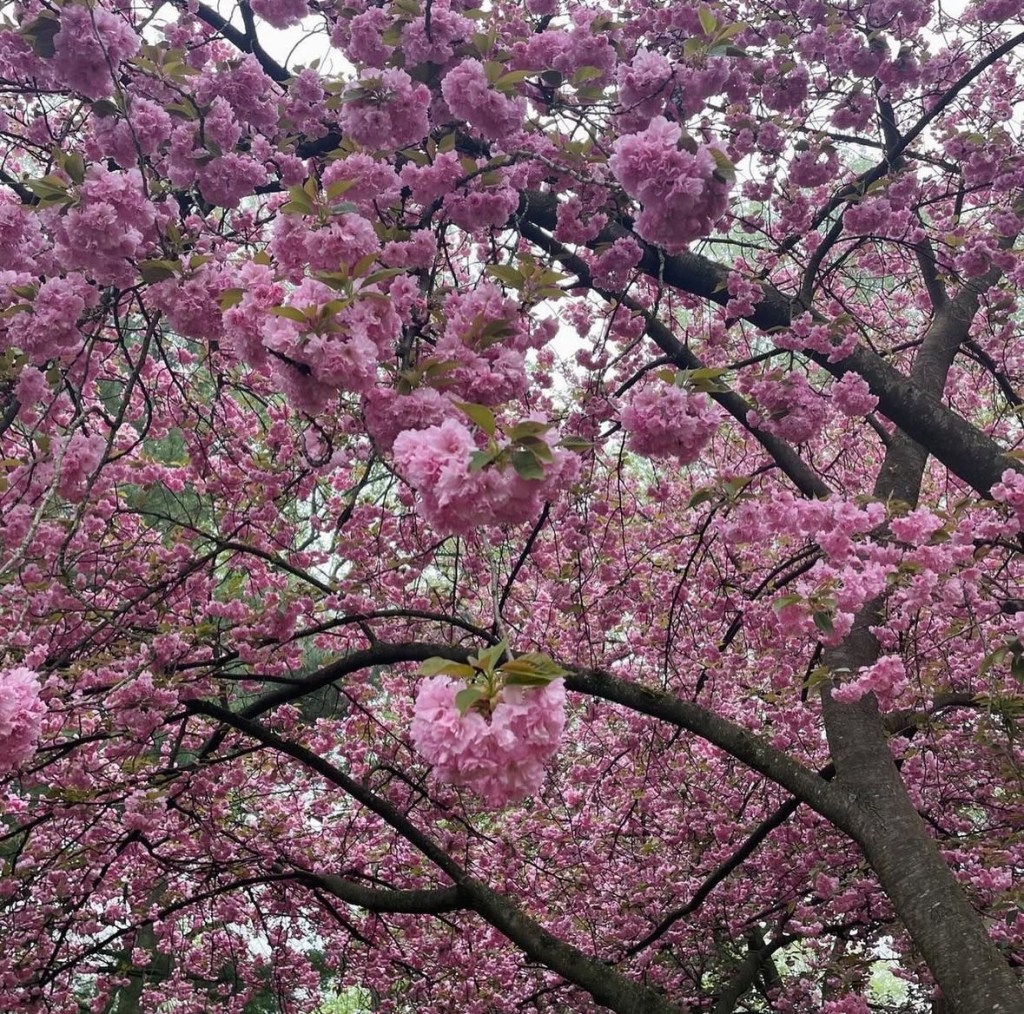
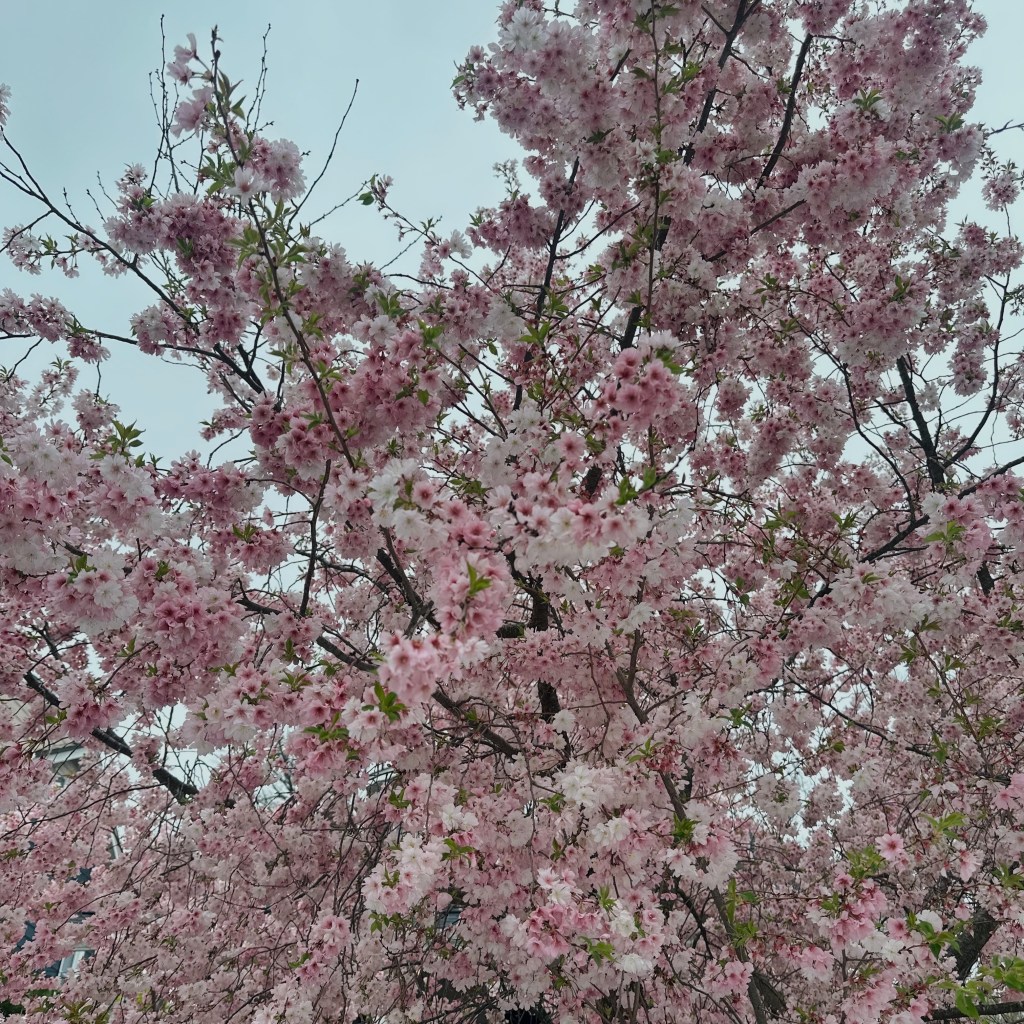
As I walked past a strip of rather modest houses, I was greeted in a sea of green by a fluffy, pink flower of a tree. The tree’s branches shot upwards in a nesting bundle with the longer, lower branches serving as the bouquet’s foundation. The inner branches had steeper slopes and had grown sharply towards the sky, though many were crookedly shaped and bore off-shooting, twig-like branches. Most of the flowered parts of the tree were covered in small, crumpled bunches of a dusty amaranth color. There were sporadic placements of bubblegum-colored flowers that looked like uncoupled pom-poms. The gentle contrast of color made the tree mesmerizing and I found that I had come to a full stop to gawk at it. The base of the trunk was entrenched by a sea of tall, thick grass and three coral-colored tulips. The home that sat just beyond the tree was rather lackluster: a tan, two-story home with evergreen trim along the windows.
I stood there motionless, staring at the tree for an immeasurable amount of time. I could imagine a barrage of adults stampeding out of the front door with their phones and cameras in hand. I imagined their teenage daughter walking out after, a little slower as she navigates the transition from porch to concrete in new heels, pinning her ball gown up with her right hand as she grips the railing with her left. She is accompanied by a date and a few pairs of friends, all equally embellished by makeup and dress. The group scurries in front of the tree, the boys loosely hanging back in their natural apprehension at being photographed. They do a few rounds of photos with the group of girls, then herd the boys to the tree to awkwardly assume a coupled stance with their dates. The parents are fanned out over the lawn capturing every angle, yelling for the group to look this or that way and kneeling in the dirt if it means they might immortalize the perfect moment.
I couldn’t help but think that the homeowners must be so proud of that tree, and especially proud that they need not boast of its beauty. They likely use this tree as the backdrop for all of their photos, especially those that mark important events to establish a strong aesthetic foundation as an emblem of their family’s happiness and success. I could imagine the wardrobe and lineup for prom, a baptism, the yearly first day of school, and Easter Church. Look at this wonderful tree in our yard, against which we lay our greatest achievements and coveted displays of social mastery; look how well we are doing. Surely a family with a tree as such is as spiritually accountable as they are socially successful; I could imagine they were quite eager for the upcoming occasion.
Easter mass is one of the two worst occasions to attend because of its crowd pull. Easter and Christmas are when people attempt to make half-hearted pleas of loyalty to their maker upon being inundated with reminders of religious obligation. We are called to remember that Jesus’ death and resurrection are the reason for the season, and encouraged to disengage from childish affections for the antics of the Easter Bunny, the very tool by which we came to appreciate this time of year. We are endeared to cherish and revel in the bountiful joy that is a long-winded sermon, tossing dollars into a wicker basket on a long pole, and adopting restrictive moral behaviors that we will immediately forget upon the return of Ordinary Time.
When you attend mass in a month such as February or June, you’ll arrive to find a seating selection of great breadth. Even if you arrive over an hour early for church on Christmas or Easter, you’ll find that most, if not all, of the seats have already been taken. There might be a few open spaces, but you’ll likely have to line up along the wall, where you will stand – and still be expected to kneel during the kneeling parts – for a minimum of two hours. As a teenager I was a weekly attendee due to house mandate, which has gifted me a well-tested comparative lens. Masses of people would roll in for holiday mass, most of whom I was not accustomed to seeing at weekly mass, to show their face to the Lord for the anniversary of his life and death. Though my own attendance was involuntary, I felt embarrassed for those who showed up so sporadically. I knew that my detached attendance would not spare me from whatever might be waiting for me after death, but it seemed that others didn’t share that same knowledge.
Patriarchs donned in long, fashionable coats guide their young families down the aisle, sporting gaudy wristwatches and clutching the keys to a Range Rover. I imagined that they each carried a punch card in the deep pockets of their coats; perhaps they were awarded their hole-punch from the priest for taking communion, or from the usher after throwing a twenty-dollar bill into the collection basket. Either way, they would not return for another hole-punch until the next celebration of Christ’s life or death. The unpleasant, seasonal reminder of the eternal damnation that haunts human existence is enough to inspire shallow faith, which manifests in unimpressive schemes to fool one’s creator with in-genuine displays of piety.
It is this sharpening of religious culture that is so unique to the springtime season, and April in particular as it harbors the peak climactic event of Christ’s death and subsequent resurrection. The newly adopted religious ferocity is of such an unbearable intensity that it smothers. Do they truly believe that God will accept this behavior as sufficient? If God is accurately depicted by the Bible, then his requirements of fealty, submission, and piety are far beyond contemporary standards. If Jesus is accurately depicted by the Bible, then his requirements of humility, compassion, and mercy are too far beyond conceivable notions. By biblical standards, reward is contingent on obedience and self-discipline; I would have to imagine that the observation of indulgently ceremonial holidays that are hinged upon the mutable patterns of lunar cycles is an insufficient method by which to display either virtue.
As long as they continue to consume the metaphorical blood and body of their savior to fill their attendance punch card, they believe they will be saved. And so all throughout the month of April they wear awful pastel tones and tacky florals; they share decontextualized quotes about God’s bountiful grace, his endless mercy, his supreme love for all of mankind except those individuals which he condemns to an eternity of suffering: a sentence that not only greatly exceeds the span of human existence but evades all conceptions of time.
I had long passed the tree by this point, continuing forward with the morning walk knowing that my feet would eventually carry me home out of habit or boredom. The moments slip by, like tap water gushing out of a rusty pipe, through my hands that prove immobile and unwilling when tested. I am looking everywhere yet I see nothing as I walk, and I am disoriented from the bright sky by the time I find my way home. I am in front of my apartment door once again; my feet have ritualistically planted themselves there as I single-handedly fumble with my keys before finally landing on the right one.
I turned to glance at the tree that lives outside my apartment, its leaves and flowers shift colorfully with each passing season. The tree is planted in a small square of dirt, fenced in by a trail of stones for protection from the magnitude of daily passersby. The surrounding terrain has been laid with multicolored bricks, supporting man-made structures such as the garbage can and iron bench that bookend the tree. Cars are frequently the tree’s backdrop, as they are parked alongside the curb just up against it. There were no cars at the moment but there was a new addition to the scene: a small cigarette butt resting atop of one of the stones.
 Femme Fatalism
Leave a comment